
EVE Frontier on Sui: Building a World Players Can Shape
A builder’s reading of Hilmar Pétursson’s Sui Basecamp talk: programmable infrastructure, an open economy, and the possibilities of sharing a universe with AI.
14 min read
Part 1 of EVE Frontier
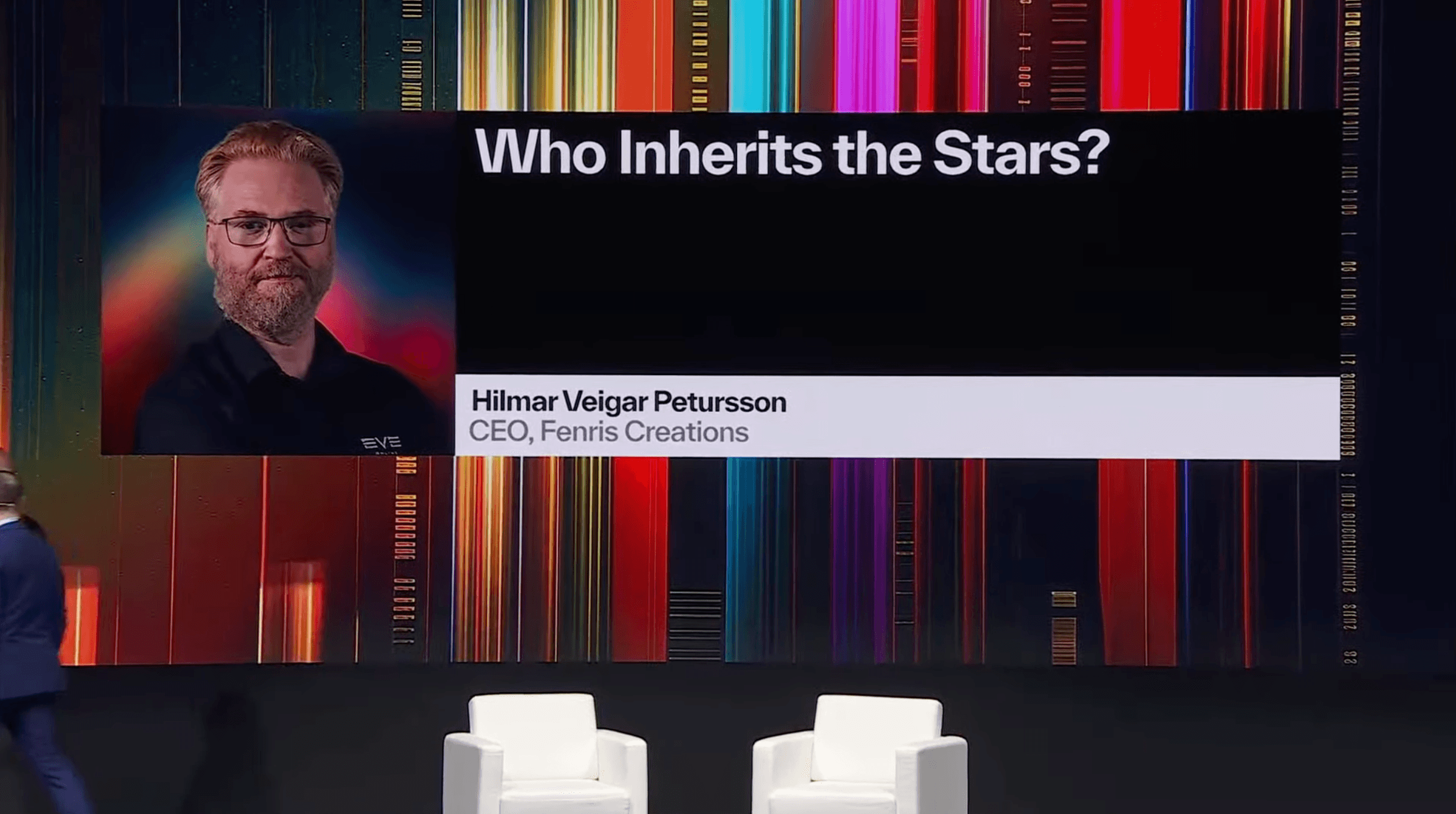
Hilmar Pétursson’s Basecamp talk explored EVE Frontier’s ambitions for a world shaped by players and shared with AI
At Sui Basecamp, Hilmar Veigar Pétursson, CEO of Fenris Creations, the studio behind EVE Online and EVE Frontier, asked who would inherit the stars: our descendants or our creations?
The clearest clue to EVE Frontier’s ambition is what players are already building. The spring hackathon’s winners created systems for governance, bounties and infrastructure management. They built institutions. Hilmar’s talk connected that emerging player society to an open economy and the prospect of sharing a world with AI.
Frontier is a survival MMO set in a broken universe. You explore, gather resources, build infrastructure and try to stay alive. Its larger ambition is to let players rebuild civilisation, including writing some of the systems that civilisation runs on. Sui provides the programmable foundation: a gate can become a business, a storage unit a market, and a player group the designer of the rules its infrastructure runs on.
I am writing this as an EVE Frontier enthusiast and builder. My projects include evefrontier.space, First Move, the Frontier app directory, diedin.space and Jötunn. I want the experiment to succeed, and I care about what it offers people building and playing today.
My reading of Hilmar’s talk is that these ideas belong together. Programmable infrastructure gives players more ways to organise. An open economy could connect what they create to a wider world. Agents would have to navigate the institutions players build, as well as the game’s underlying rules.
There is plenty still to prove. There is also already something worth building on.
What Frontier inherits from EVE
Hilmar began with EVE Online’s history: 23 years online, around 700,000 daily trades and 270 million spaceships built, according to the figures he presented.
Those numbers establish scale. The more interesting inheritance is what people do when they share a world where their decisions have consequences.
EVE players organise supply chains, negotiate agreements, run alliances and manage resources. Someone has to move the fuel. Someone has to keep the accounts. Someone has to persuade a group of people that defending a particular piece of space is worth their evening.
Hilmar calls the human benefits of this the EVE Effect. In the studio’s survey figures presented at Basecamp, 73% of players reported making new friends through EVE, and 56% reported using skills learned in the game in real life. These findings are from surveyed players, not proof that everyone has the same experience. They still give a useful picture of what committed players value.
His explanation of friendship brought together proximity, frequency, duration and intensity. Spend time with people, see them often, and go through something that matters together.
In EVE, loss provides some of that intensity. A destroyed ship matters because someone built it, someone paid for it, and someone chose to put it at risk. Hilmar also emphasised what makes a difficult experience bearable: understanding what happened, a prospect of recovery and people who help you recover.
That last part matters. Harshness alone is not a community strategy. The interesting question is whether a world gives people reasons to rely on one another, and enough room to rebuild when things go wrong.
Frontier takes that question into a different setting. If players can program infrastructure, they can create more ways to cooperate. The person writing the rules for a trading post becomes part of the society, alongside the trader, the hauler and the pilot defending it.
Why Sui matters to the game
Frontier’s use of Sui makes sense when you look at a structure you might encounter in space.
Take a Smart Gate. It connects places, but its owner might also want to charge a toll or restrict access. A storage unit can offer goods under a set of trading rules. A turret can use custom targeting logic.
These are examples from Frontier’s Smart Assembly modding documentation. Players write Move smart contracts to customise supported structures. Move is the programming language used for Sui contracts; Smart Assemblies are the in-world infrastructure those contracts extend.
The world contracts have three layers: basic modules for mechanics such as inventory and fuel, assemblies that combine them into usable structures, and player extensions that add behaviour. Assemblies are shared Sui objects, with their interactions constrained by the contracts.
For a player, the result can be straightforward: arrive at a gate, meet its conditions and pass through. For a builder, it creates a space to design those conditions.
There are boundaries. Publishing a contract does not give you control over somebody else’s infrastructure. Assembly owners authorise extensions, and Frontier’s ownership model uses capability objects to grant access to particular objects. Permission is part of the system you are building against.
I think that is an important part of the appeal. Open building needs clear ownership. A public world would be of little use if anyone could rewrite the rules of your base.
Hilmar also highlighted parallel execution, low fees and fast finality. The precise performance point is that Sui can schedule transactions with non-overlapping inputs in parallel. Activity that competes to change the same object still has dependencies. That is a stronger explanation than treating millions of simultaneous player actions as an established game benchmark.
For me, the object model carries the more distinctive argument. Infrastructure has state, permissions and behaviour that other systems can interact with. Builders can create interfaces around it, or extend what it does within the available rules.
Consider a gate business. One builder writes the toll logic. Another makes an interface for its customers. A player group uses it as part of a trade route. They still have to earn customers and get the design right, but they have a common foundation on which to build.
My part of the Frontier: helping people build
My own projects build on that foundation: learning the language, finding useful tools, and making the world’s data easier to understand.
evefrontier.space brings community resources, official documentation and builder projects together. There is a practical need for that. Someone arriving from EVE may know the game’s social world but be new to Move. Someone arriving from Sui may know contracts but be unfamiliar with the Frontier. Both need a way to find their bearings.
First Move is an interactive course for learning Move and then applying it on Sui. It runs in the browser and uses a real Sui Move compiler, so learners can write code and get feedback without setting up a local development environment.
Giving players programmable infrastructure creates an opportunity. Helping more people learn how to use it makes that opportunity accessible.
The app directory addresses discovery. As the community builds more tools, people need somewhere to find them. A project can be technically impressive and still struggle to matter if the players who could use it never hear about it.
Jötunn takes the data side into a character dashboard, bringing together information such as on-chain stats, tribe history, kills and events. It is a practical example of turning accessible data into a player-centric view.
I also built diedin.space, a killmail board for an earlier Frontier cycle, a record of the losses that help tell the world’s story.
Together, these projects show where I see a role for myself in the ecosystem. Some builders will create elaborate systems inside the game. Others will make those systems easier to learn, discover and use.
Both matter. A civilisation needs infrastructure, but it also needs people who can understand and operate it.
That is why I find Frontier’s builder community interesting already. There is room for education, interfaces and community resources alongside contracts. You do not have to begin by designing a new economy to contribute.
The hackathon produced institutions
The EVE Frontier × Sui hackathon gives a more concrete picture of what this can become.
The studio’s April results announcement reported more than 800 participants and more than 120 projects competing for an $80,000 prize pool. Hilmar’s Basecamp slide gave the more specific figure of 128 submissions.
The overall winners were:
Project | What it adds to the world |
|---|---|
Systems for player governance, logistics, defence and economic coordination | |
Blood Contract | Bounties with defined conditions and automatic payouts |
An interface for managing infrastructure and access rules |
These are institutions. They organise cooperation, incentives and control over shared resources.
That is the kind of building I want to see more of: systems players use because they solve a problem inside the world. The test over time is whether people adopt them, depend on them and keep improving them.
An open economy, with a development path
Hilmar’s economic comparison was between EVE Online’s contained economy and Frontier’s ambition to connect with external markets.
There is a distinction worth getting right here. EVE Online already has an official route from real money into game value: players can buy PLEX and trade it for ISK. What players cannot do is freely cash out their game assets through an authorised marketplace. Unsanctioned real-money trading is prohibited.
Frontier’s proposed change is broader economic interoperability. Its economic pillars describe a connected, composable economy that can interact with other virtual and real economies. On stage, Hilmar positioned the EVE token as a foundation for value moving into and out of the world.
The distinction looks like this:
EVE Online | EVE Frontier’s intended model | |
|---|---|---|
External money | Official purchases, including PLEX, bring value into the game | An economy designed to interact with external markets |
Value leaving the game | Player cash-out and unsanctioned RMT are prohibited | External exchange is part of the economic ambition |
Player systems | Businesses and organisations operate within the studio’s game systems | Players can also build contract-based infrastructure and services |
For builders, an open economy creates room to test a wider range of business models. A service earns repeat customers by moving goods reliably, coordinating infrastructure or saving people time.
That is the version of an open game economy that interests me: value arising from something people want to use. Tradability by itself tells us little about whether a service is worth paying for.
It is also important to distinguish the roadmap from the current game. Frontier migrated to Sui testnet on 11 March 2026. Its roadmap places Sui mainnet and the EVE token in a later phase. The FAQ says cycle wipes continue until launch.
There is a live builder environment today. The full economic ambition is still being developed. Those are different milestones, and I would judge them separately.
What Iceland’s history adds
Hilmar used Iceland to illustrate the difference between an economy with capital controls and one with freer capital movement. The slide divided that history around 2001, but the actual reforms followed a longer sequence.
Iceland completed the liberalisation of short-term capital movements in mid 1990's. In March 2001, it changed its monetary framework, adopting inflation targeting and removing the króna’s exchange-rate fluctuation limits. Capital controls returned after the 2008 banking crisis. Most restrictions affecting households and businesses were lifted in 2017, with the last post-crisis capital-account restrictions removed in 2021.
The fuller history strengthens the analogy. Openness creates opportunities, and it also changes how shocks travel through an economy. It does not make liquidity reliable or remove the need for sound institutions.
The regulatory framework is also still developing. Hilmar’s slide names a U.S. market-structure bill as part of the proposed legal framework. On 15 September 2026, the Senate rejected cloture on the motion to proceed to the CLARITY Act, 49–50. A motion to reconsider followed. That was a procedural setback, rather than a final rejection of the legislation. Technical access to markets and legal permission for particular assets and services remain separate questions.
Where the chain ends today
The same care is needed when discussing how much of Frontier is on-chain.
The public contracts make important rules inspectable, but the current world remains a hybrid. The world explainer says locations are stored as hashes and proximity verification currently uses signatures from a trusted game server.
That is a meaningful boundary. A contract can enforce an interaction while relying on the server to attest that a game condition has been met.
I see a practical reason for keeping some information hidden. Exploration, ambushes and concealed infrastructure depend on people knowing different things. Publishing every coordinate would change the game.
That said, public contracts and a fully autonomous universe are different achievements. Frontier’s digital physics whitepaper recognises privacy, scalability and longevity as continuing challenges.
For builders, the boundary needs to be clear: what is enforced by your contract, what comes from the server, and what can change during development. Clear answers make it easier to build something players can trust.
Why agents belong in this discussion
The AI part of Hilmar’s talk becomes more interesting once you have a picture of the world agents would enter.
A trading agent might have to deal with a player’s market. A hauling agent might need access through a gate whose rules another player wrote. Reliable service could matter alongside price. Agreements could become part of a longer relationship.
That is the research opportunity in a programmable world: participants can change the environment an agent must learn to navigate.
Google DeepMind’s account of the partnership highlights continual learning, memory, long-term planning, and complex interactions between agents. Its programme begins in an offline instance of EVE Online, then progresses through Frontier to study coexistence. Bringing mature capabilities into live EVE Online and EVE Vanguard is a later possibility.
At Basecamp, Hilmar laid out four research stages, ranging from near-term work to a speculative north star.
Research horizon | Agent | Proposed role |
|---|---|---|
Now | The Scout | Explore and trade |
Next | The Contractor | Provide services that humans hire |
Later | The Enforcer | Take and hold resources |
North star | Explore and trade | Organise and govern |
Condensed from Hilmar’s research roadmap. The horizons describe a research direction, with increasing speculation towards the Sovereign stage.
The connection I found most compelling was with the earlier EVE Effect discussion. Coordination, negotiation, reliability and leadership are skills people practise in EVE. They are also capabilities agents would need to take on more substantial roles in the Frontier.
For me, EVE’s social complexity is the attraction: there is no single winning move. A good decision today may depend on what happened last week, on who trusts you, and on how other participants respond tomorrow.
Hilmar also compared seven virtual worlds as environments for agents. The two EVE rows show the distinction he was making:
Dimension | EVE Online, per the slide | EVE Frontier, per the slide |
|---|---|---|
Persistent multi-agent world | Extreme | Extreme, by design |
Irreversible consequences | Extreme | Extreme |
Agent access through tools or APIs | Restricted | Native |
Composable, open environment | Partial, read API | Full, SDK and on-chain |
Condensed from Fenris’s Basecamp comparison slide. These are the studio’s ratings. Frontier’s persistence rating was marked “by design”; development cycles still end in wipes.
Hilmar’s comparison highlighted persistence, consequences and agent access. Frontier’s strongest ratings reflect its design ambitions, with several capabilities still to prove in practice. The compelling idea is how those qualities come together: a world that players keep changing, where decisions carry lasting consequences and agents must navigate the goals and actions of others.
His introduction of the EVE AI Lab extended that ambition to a place where agents could be studied among people before taking on roles in the wider world.
Sui is relevant here because agents could interact with exposed contract functions, subject to the same permissions and checks those functions impose on other callers. That would give builders a common way to design services for different kinds of participants. It would not, by itself, give an agent access to every game action or tell it how to behave.
The questions worth building towards
I came away with three questions that I think will shape whether this becomes a world people want to inhabit for years.
Will useful services create opportunities for ordinary players and builders?
An open economy could reward people who make the world easier to navigate, trade in or organise. It could also concentrate advantage among participants with better capital, information or automation.
The test I care about is whether solving problems keeps creating room for newcomers. Can a small builder earn trust through their work? Can a player find customers for a dependable service? Does the economy give people reasons to build relationships as well as accumulate assets?
Will agents strengthen the social experience?
There are plausible benefits: help with routine logistics, companions for exploration, or services available when other people are offline. Automation could also reduce the occasions when players need one another.
The EVE Effect gives Frontier a useful standard to aim for. I would want agents to expand what people can do together. Player understanding matters too: people should know what research participation involves, where agents are operating and what protections apply. Starting research offline is a sensible step; coexistence in a shared world needs its own design.
How will recovery work as the world becomes more permanent?
The experiment Hilmar described allows room to try, learn and restart. Frontier’s current cycle wipes provide one form of that flexibility.
As the project moves towards mainnet and longer-lived economic systems, recovery becomes more complicated. Resetting game state, changing contracts and addressing losses connected to external assets are different operations. Mainnet does not make every kind of reset impossible, but it makes the expectations around one more consequential.
Builders will need to know how upgrades, incidents and recovery work. Players will need to understand what persists and what can change. That clarity is part of making a durable world, especially while the underlying game is still evolving.
A world worth contributing to
The most exciting thing in Hilmar’s talk was the space it leaves for players to contribute.
EVE Online demonstrated how much people can create through trade, conflict and cooperation. Frontier is trying to give them more direct ways to build the infrastructure behind those activities. Sui makes an important part of that infrastructure programmable and accessible to outside builders.
The early evidence is concrete: people are learning Move, building interfaces, creating bounty systems and designing tools for coordinating player societies. The open economy and the broader agent ambitions still have to earn their place through development and play.
That is enough to keep me interested, and enough to keep building. My own contribution is helping people find the tools, learn the language and make sense of what is happening in the world.
Hilmar asked who inherits the stars. For now, I am drawn to a more immediate question: what can we build there together?
This article draws on my notes from Hilmar Pétursson’s Sui Basecamp talk and the linked documentation and announcements. Statements about current status reflect the information available on 7 October 2026. My builder projects are linked above; this is my perspective as a community participant.
Slide screenshots: Hilmar Pétursson’s Sui Basecamp presentation.